


Band Scale
BELT SCALE
Belt Scales are scales designed to measure the material carried by conveyors on the belt. Obtaining instantaneous and total flow rate information of the material passing through the conveyor constitutes very important data for the manufacturer.
In order for the belt scale to work with full efficiency in the place where it will be installed, some elements must be carefully examined. Since the conveyor belt scale is installed on the customer's usually existing belt, the mechanical structure here needs to be technically examined. For example, if the mechanical construction is weak, it should be strengthened, if there are problems such as tears and joints in the existing tape, it should be replaced and vibration should be prevented. Apart from this, if the area where the belt weigher is installed is windy, this section must be covered with a shed.
The condition of the material passing through the belt scale is also a very important issue. Effects such as the arrival of lumpy goods, material not being homogeneous, and water leakage from the material seriously affect the uncertainty, that is, accuracy of the weighing.


SELECTION OF THE PLACE WHERE THE BELT SCALE WILL BE INSTALLED AND RULES TO BE FOLLOWED
1 ) The belt thickness and weight of the belt scale are the same throughout the entire belt.
2 ) Belt scale tensioner must be vertically weighted, horizontally weighted tensioner may cause load-dependent oscillations in belt tension. This negatively affects the weighing.
3 ) The belt weighing bridge with magal should be chosen in an area where it will not deflect more than 1 mm at full load. It is not appropriate to install a belt scale in systems that have structures that may create similar vibrations such as screens, crushers, vibro feeders, etc.
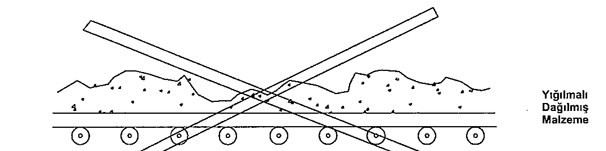
4 ) The material carried in the belt scales should be spread homogeneously as soon as it reaches the weighing bridge. While the material is in the measuring area, there should be no effects such as backward flow of the material or rolling, and the material should come homogeneously in a smooth cross-section.

5) It is appropriate to install the weighing bridge at least 3-4 rolls away from the tail and head drums in V and triangular section belts.

6) The slope of the conveyor belt directly affects the weighing accuracy. (Accuracy of 2% of the nominal capacity may vary from 20° to 45°. In general, after 18 degrees, most of the materials start to flow back and it cannot be prevented, so it is not right to install a belt scale after this degree. The ideal thing is to make a nearly straight design on the conveyors where the belt scale will be installed.
7 ) The most effective and accurate measurement area on conveyors is 3 inlets and 3 units. It would be appropriate to install the weighing bridge before the exit roller.

8 ) The point where the conveyor belt is most tense is the parts close to the main drive drum. Therefore, when choosing the place where the weighbridge will be installed, the farthest point possible from the main drive drum should be chosen as the installation location.
9 ) The conveyor where the belt scale will be installed should be min. 4.5 meters should be a maximum of 120 meters.
10 ) In all conveyors with a slope, the installation should be carried out after leaving 12 meters of space on the upward turns and 6 meters on the downward turns from the slope end roller, where the belt scale will be installed.
]11 ) If there are side guides on the conveyor, they should be placed on the weighing band. It should be adjusted so that it does not touch. Lifting it too high will not be suitable as material will get in the way and cause jamming.

12 ) Belt scale is very susceptible to all environmental effects and to be affected by the uncertainty of the error in line with these environmental factors. In this regard, attention should be paid to daily or frequent maintenance work to prevent weighing accuracy from being affected.
- Rollers and roll groups should be lubricated.
- Band tension and belt slippage should be adjusted.
- If there is material adhering to the surface of the belt, it should be cleaned. If this situation involves continuity, it would be appropriate to install a suitable scraper device that will not affect the weighing.
- Welding should not be done on and around the conveyor without taking the necessary precautions.
- Overloading of the weigh bridge should be prevented during maintenance.
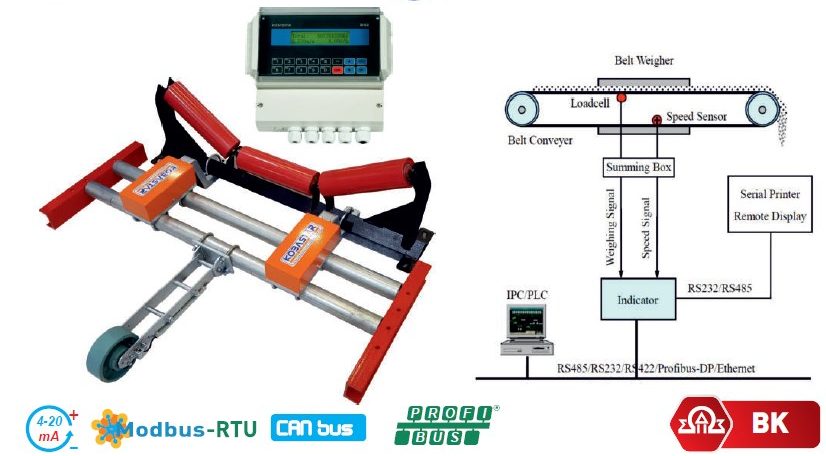
BK Model belt You can review the scales here.